Wednesday, January 28, 2015

Social Media for Small Business: Which Social Media Platform is Right for Me?


As a small business, you have many challenges you face every day. Not only is your time spread thin, your dollars are stretched tighter than pantyhose on Miss Piggy. And you still have to work on your business while you are working in your business.

Here is an important quote from Henry Ford.

“A man who stops advertising to save money
is like a man who stops a clock to save time.”

Even with everything else you have going on in your business, you must make the time and the investment to market your business. For small businesses, social media is an excellent way to continue to market your business without a large investment of money. But it does take time, and you have to start somewhere. So how do you navigate the many different social media opportunities available to you?

To help cut through some of the clutter, this will be the first in a series of articles on Social Media for Small Business. We will start with the top seven social media sites that are appropriate for small business – Facebook, Instagram, Google+, LinkedIn, Pinterest, Twitter and YouTube.

To aid in breaking down the overwhelming amount of information, we've created an infographic that illustrates the most useful information about each of these sites. Click on the graphic to open a larger version in a new window.
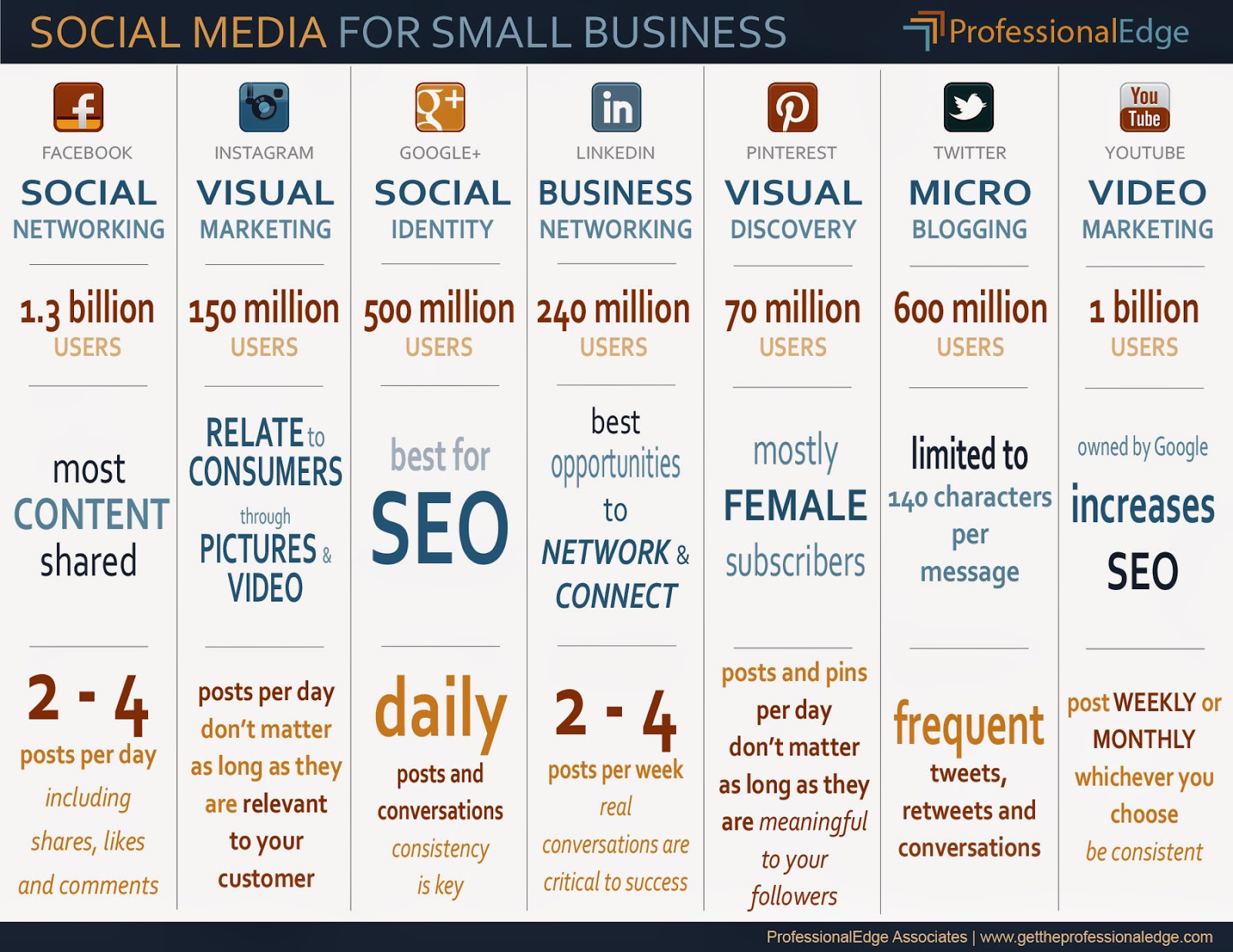
 Social Media Infographic developed by ProfessionalEdge


In this article, we will focus on how to determine which social media opportunities will work best for your business.

Let’s start with what each of these sites can do for you.

Facebook is a social networking site with 1.3 billion users and growing rapidly. Because of this high number of users, it is where the highest amount of content is shared. Facebook is a medium for businesses who want to connect with individuals or other small businesses. It’s a great place to post important information about your business and to have conversations with customers and potential customers about how you can meet their needs.

Instagram is a visual marketing site with 150 million users. It allows you to relate to consumers through pictures and video. Instagram is a medium used by photographers and videographers to showcase their talents and could also be a good way for small boutiques, fashion designers or similar small businesses to post photos of their merchandise.

Google+ is a social networking and identity site with 500 million users. Google+ is similar in a lot of ways to other social networking sites, so you may think it is redundant. But consider that is owned by Google, one of the largest search engines in the world, so every time you post on Google+ it increases your SEO (search engine optimization). Google+ also includes an authorship tool that associates web-content directly with its owner/author.

LinkedIn is a business networking site with 240 million users. It offers opportunities to network and connect with business associates and potential business customers. It is best used to make and cultivate connections for your business.

Pinterest is a visual discovery site with 70 million users, the majority of whom are female. This site allows you to post or pin pictures of things you like or want to share and to connect with others through their pins and posts. Pinterest is a tool to enhance your other social networking by sharing pins and posts on other sites. Small businesses who want to share photos of their merchandise, recipes or items in a portfolio should consider adding Pinterest to the mix.

Twitter is a micro blogging site with 600 million users. Each post is limited to 140 characters and can now also include a graphic or photo. Twitter is used primarily to share real-time information about what is going on in your business. It is a tool for on-the-spot communication about events, sales and other promotions and can also be used to share blog posts and other important information about your business. Twitter takes an investment of time overall, but there are many tools available to help you schedule and plan posts in advance. We’ll talk about them in more detail in a future article in this series.

YouTube is a video marketing tool with 1 billion unique users each month. It is owned by Google so it also helps increase SEO. YouTube provides and opportunity for businesses to share how-to’s, training and other informational videos about your business that can be added to posts in other mediums to increase visibility. Creating videos doesn't have to be expensive and can be done on most laptops or tablets now with only an investment of time. They should be considered as an add-on to any small business marketing strategy.

That is each of the top 7 social media opportunities in a nutshell. There are of course many other ways for businesses to use each of these sites. Please comment below to share how you are using these or other sites or how you want to incorporate them into your small business marketing strategy.

Please take a moment to share our blog with your colleagues and friends who you think may benefit. The next article will dive further into each of these sites and talk about good posting strategies to enhance your social media effectiveness.

__
Kerry Brooks is Co-owner of ProfessionalEdge Associates, offering a wide range of marketing, event planning and support services to businesses that want to increase their success, but aren't in a position to add to their staff. Learn more at www.gettheprofessionaledge.com.

Thursday, January 15, 2015

Social Media Series for Small Business – An In-depth Look at LinkedIn for Your Small Business

This week we are back to our Social Media Series for Small Business with an in depth look at LinkedIn.  To date, we've talked about which Social Media sites are best for your business and what good posting strategies you should be using, and we've taken an in depth look at Facebook for small business.

Let’s take another look at the enhanced version of our Social Media for Small Business Infographic.


As we reviewed before, LinkedIn is a business networking site with about 240 million users. The best use we've seen for LinkedIn is a networking tool for those out of work or looking to move in a different direction with their career.

But LinkedIn can also be a great tool for small business.

First, start by creating a LinkedIn Company Page to raise brand awareness and teach potential customers about your products and services.

Use your posts to attract followers to your company page. Followers are key to driving word of mouth, recommendations and referrals. The more quality followers you have, the more you will increase your reach and engagement.

You can start increasing followers by asking your employees to add your company page to their personal profiles. By doing this they are automatically following your company page and can like and comment on posts about your company. Do the same from your personal page and you've just expanded your company page’s reach significantly.

Next, ask your customers and potential customers to follow your Company Page – include links to connect on your website and other social media as well as in your email communications.

Increase your exposure by posting regularly. Share company news, industry articles and start key discussions about topics important to your customers and potential customers. We recommend 2 - 4 times per week; others may recommend daily. Like every other social media site, the key to success is to have a strategy and be consistent.

LinkedIn may take a bit more effort to cultivate, but the opportunities to expand your network may well be worth the investment of your time.

How are you using LinkedIn to benefit your small business?
__
Kerry Brooks is Co-owner of ProfessionalEdge Associates, offering a wide range of marketing, event planning and other support services to businesses that want to increase their success, but aren't in a position to add to their staff. Learn more at www.gettheprofessionaledge.com.


Thursday, August 28, 2014

Ten part series on starting a business - Part 5

Pricing and Bidding


One of the most challenging aspects of starting a business, particularly if you are providing a service, is determining what to charge and how to bid.  It might be best to come at pricing from two different directions.  First, if possible, do some research and see what other companies are charging for similar services.  Second, put together a budget including expected expenses and projected revenue, and figure out what you need to charge to cover your expenses.  Budgeting can be especially challenging when you are starting out, because you will not know all of your expenses or what to expect for revenues, but do your best to come to a reasonable budget. 

Study the numbers you have derived from each of these processes, and determine what you will ultimately charge for your services.  If your business is pricing a product, the process is similar, but it may be easier to find out what the market will support and what others are charging for similar products.

Often a business providing a service must submit a proposal or bid to an organization in order to gain them as a customer.  Take care to put together proposals that answer each specific requirement in the request, and be sure that it is professional.  You may find it helpful to read books or take a class on how to write a proposal. Note that each organization/project will want information in different ways.  Some will ask for an hourly rate, some will want a project cost.  Some may not tell you what they want.  Expenses will be handled differently.  For example, if travel is required, the company may pay for that separately, or you may have to include that in your costing strategy.

Competition can be tough depending on your industry and potential customers, especially when you are just starting out and trying to make a name for your business.  Do your homework, be diligent, and don’t get discouraged. 
___
Kim Luedke is Co-owner of
ProfessionalEdge Associates, offering a wide range of marketing and support services to businesses that want to increase their success, but aren't in a position to add to their staff.

Tuesday, June 24, 2014

Don’t Forget to Feed the Monster Before it Gets Hungry


Your small business is a being. It’s a living, breathing, moving, growing, changing being. It needs to be fed in order to keep it fat and happy.

Think about how you feel when you skip a meal or don’t eat right. Your stomach gurgles, your energy level is low and your mood changes.

This is the way many entrepreneurs are with their small businesses. They work every day on what will bring them revenue today or two weeks from now and forget to feed their business with leads and contacts that will help them be full further down the road. Occasionally, they’ll stop and send out a single post card or email or post something on Facebook, but there are large gaps in between and not a good balanced meal to sustain the company’s energy, so the results are not what they expect.

Imagine instead if you devoted a percentage of your time and a dedicated monthly budget to your business. The old adage of paying yourself first applies to your business as well. It doesn't have to be a huge amount of time, or a huge amount of money. It just has to be consistent. Start with an hour or two a week and $500 - $1,000 per month.  That doesn't sound like much time or money to invest in marketing, but it can go a long way. It’s much more about getting started, being strategic and keeping it going than about how much you can do today.

If you start with a small budget and you’re not a marketing guru, invest in a consultant to make the most of that budget for you. The right consultant can stretch that amount each month into a good mix of marketing and social media to get you the best reach for your investment.

Then, invest the limited time you have into communicating and providing information about your business to that consultant and then to networking as much as possible to cultivate current connections and add new ones. The consultant can take the information and turn it into blog posts, social media posts, email campaigns and other marketing and advertising to come up with the right mix to maximize your investment and always keep you in front of your target audience.

You also must have realistic expectations. With a small investment of time and money, you won’t see huge results immediately. So don’t give up after a month with no immediate results! With consistency, you will start seeing your business and your brand awareness increase. Over time, you will solidify your brand and your network will grow. So as you have new products or services to offer down the road, your monster will be full of new prospects and potential customers to sustain your business.

Is your monster being fed a good meal consistently or is that a gurgle you hear?

__ Kerry Brooks is Co-owner of ProfessionalEdge Associates, offering a wide range of marketing, event planning and other support services to businesses that want to increase their success, but aren't in a position to add to their staff. Learn more at www.gettheprofessionaledge.com.


Tuesday, June 17, 2014

Take Time to Pay Attention to the Simpler Things

Last week, I read a blog that made me take a break from all of the technology and contracts and stress of life and stop to think about the simpler things.

It was about how to give your 2014 kids a 1970s summer.  It made me laugh. In fact I’m still laughing. And it brought back many wonderful memories of leaving the house at 7:00 in the morning and not coming back until after playing hide and seek at dusk. Riding bikes. Bouncing from house to house and slapping together sandwiches at whoever’s house we were at when we got hungry. Lemonade and Kool-Aid stands. Cartwheels and Red Rover on the front lawn. Playing in the sprinklers. And laughter. So. Much. Laughter. Thank you Melissa Fenton and @_MommyPage for the fabulous flash back.


We thought it would be fun to take a look at what was happening with business and technology back in the 1970s too. Here are just a few kind of important things that happened during that decade:
  • Southwest Airlines made its first flight in June 1971
  • Federal Express was founded in 1971
  • The earliest floppy disks were invented at IBM; they were 8 inches wide and became commercially available in 1971
  • The first e-mail transmission took place in 1971
  • The first voicemail system, known as the Speech Filing System (SFS), was invented by Stephen J. Boies in 1973
  • On April 3, 1973, the first cell phone call was transmitted
  • Microsoft was founded on April 4, 1975
  • Apple was founded April 1, 1976
  • Oracle was founded in 1977
  • The microprocessor, spreadsheets and the C programming language were invented
  • Pocket calculators and the Sony Walkman were built
  • Microwave ovens and VCRs became commercially available
  • In 1979 e-commerce was invented

Clearly, the 1970s saw many inventions and thriving entrepreneurship. Technology grew by leaps and bounds. And it has never stopped.

Hmmm. Any correlation between that and the “forced smile-inducing, uber planned and supervised, over-the-top summer life experiences” parents are providing these days?

Technology is an amazing thing. It’s what allows us to run our business when we live in different places and our customers are in other different places. That’s not something that could have happened in the 1970s and not something to be taken for granted.

But, this article reminded me to take more moments to remember the simpler things and break the ‘rules’ more.

In fact I've just used an app to put that on my To Do list in the cloud so it will trickle down to all of my various technology devices. J


How do you take time to remember the simpler things?
__
Kerry Brooks is Co-owner of ProfessionalEdge Associates, offering a wide range of marketing, event planning and other support services to businesses that want to increase their success, but aren't in a position to add to their staff. Learn more at www.gettheprofessionaledge.com.